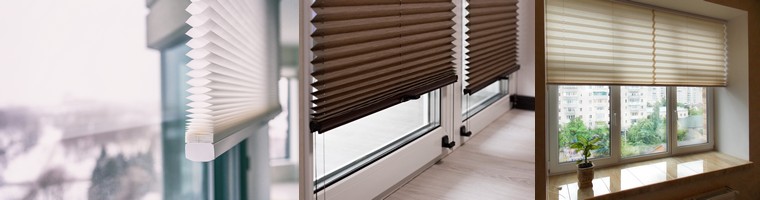
The main advantage of pleated blinds is their design. Unlike a classic roller blind they have no roller tube. The mechanism is two metal rails that enclose the fabric and form an accordion fold.
Pleated blinds, also called pleated shades, are a practical way to handle strong sunlight in homes and offices. They give privacy from neighbours and passers-by and work as a decorative element at the same time. Models with a double fabric, known as duettes or double pleats, also insulate: they reduce heat gain in summer and help keep warmth inside in winter.
Pleated blinds for medium-sized windows
Pleated blinds suit windows that need blackout or only softer light. Depending on the model, the fabric moves vertically in one or two directions across the glass. You can cover a chosen part of the window without darkening the whole room, which helps with strong sun or street lighting.
The fabric sits between two rails that slide along the frame, up and down. The blind can sit at the top, in the middle or at the bottom, or cover the whole pane. The fold stays visible even when the blind is fully extended. The profiles can be fitted vertically or horizontally. A horizontally fitted pleated blind works the same way, but the fabric travels along the top and bottom of the frame.
No cassette is required. The blind therefore takes less space and sits close to the window, so it complements the interior instead of dominating it. Colours of hardware and fabric, together with different textures, make it easy to match the blind to the rest of the room.
Sizes, shapes and skylights
Made-to-measure pleated blinds adapt to different sizes, including large panes and conservatories. They can also follow windows that are not rectangular: oval, arched or trapezoid. The same flexibility applies to skylights. Attic rooms heat up more, because both the glass and the roof surface take the sun. Roof-fitted pleated blinds limit that inflow and reduce the risk of the room becoming too warm.
Large windows are part of modern architecture in homes and public buildings. They give light and space, but they also let in a lot of heat when the sun is on the glass. Pleated blinds protect against the sun and against views from outside, and remain a quiet part of the interior.
Fitting, control and child safety
Fitting is straightforward and can be done without drilling the frame. Non-invasive pleated blinds are held by special brackets. Another option is to screw them to the glazing beads or into the window frame.
Pleated blinds are operated by hand, by moving the profiles up or down. Electric control is also available. Many versions have no hanging cords, chains or other parts a child could swallow, which makes them suitable for children's rooms. Always read the child-safety sheet before fitting.
Fabric for the room
Fabric texture lets you match the blind to how the room is used and how large it is. Sheer, lightweight fabrics work in living rooms, kitchens open to the living room, and studies, where daylight should remain even when the blind is down. In smaller rooms that light keeps the space from feeling optically smaller.
Blackout fabrics that stop the light suit bedrooms and attic rooms. Shutting out the sun can lower the temperature in warm weather. Blackout fabric also helps at night in houses near a city centre, where street lighting and other artificial light are strong.
Order, read the guide or view the gallery
If you have ordered before and already know what you need, go straight to the configurator. The guide covers the whole process: measuring, ordering and fitting made-to-measure pleated blinds. The gallery shows fitted examples and the differences between the pleated types we supply.
- Open the pleated blind configurator
- Pleated blind guide
- Pleated blind gallery
- Examples of fitted pleated blinds
- Pleated blinds – guides, models and made-to-measure
Technical information
Product sheets for Cosiflor, Vegas and Rippo. Each link opens a PDF with sizes, models and technical details.
- Cosiflor pleated F1-F2-F3 – technical info
- Cosiflor pleated VS1-VS3-SD – technical info
- Cosiflor pleated VS2-KL-SC-FS – technical info
- Cosiflor pleated FDS3-FDS4 – technical info
- Vegas pleated PB-VS – technical info
- Cosiflor pleated FS1-FS2 – technical info
- Rippo pleated RP-R1-R2 – technical info
- Rippo pleated RP-R4 – technical info
- Rippo pleated RP-R5 – technical info